Thursday, October 10, 2013

The Faerie Queen: Spenser's Allegorical reality

Though Edmund Spenser was not the first or last author to write in allegorical format, The Faerie Queen is written in a broken up and more complicated version of the popular literature technique.

            William Harmon’s A Handbook to Literature defines an allegory as “a form of extended metaphor in which objects, persons, and actions in a narrative are equated with meanings that lie outside the narrative itself”.  Simply put an allegory is a big symbolism or abstract of a bigger picture or story. Much like the parables Jesus spoke in throughout the New Testament, or Dante’s description of the various stages of hell, an allegory is a meaning within a story (inception) that goes beyond the surface text. The overlapping of two realities tends to enrich the plot and confuse the reader at the same time, making the literary technique powerful yet complicated without background information, and “evok[ing] a dual interest” that deepens meaning. It’s important to note the difference from allegory and symbolism though: a symbol is in physical reality and the allegory exists in a separate one. While the literal season of spring symbolizes rebirth, the lion tamed by Una’s innocence and killed protecting her is a metaphorical representation of Christ’s sacrifice for humankind to be cleansed.


            In Spenser’s Faerie Queen, the basic plot is that of a knight out to slay a dragon, accompanied by a fair lady and running into several obstacles. This plot line is extremely basic, especially for the time period, so therefore one is forced to look for a deeper meaning within the text. With the Red Cross Knight representing the virtue of holiness, Una being purity and oneness, and several obstacles as sin, duplicity, rage, and more, The Faerie Queen becomes an allegory for several layers of religious, political, and nationalistic debate. RCK slaying the monstrous dragon represents holiness overcoming the disgusting corruption in the Catholic church The story on the surface is “a chivalric romance, but it embodies ideological meanings”(Harmon 12). Spenser’s use of reoccurring themes such as propaganda against Catholicism, characters as virtues, and hidden details within names and actions enriches the overall allegory. While the main story is a dramatic battle of chivalric knighthood, deceit  and entrelacement of story lines, Spenser strives to call attention to the stronger meanings of the allegory. 

            Though the technique of allegory is not new, the debate of its definition and development over the centuries is new. Critic Walter Davis states, “the concept of allegory is desperately in need of historicizing. As if we cannot bring ourselves to believe that a literary technique two millennia old never changed at all, we frequently treat it in critical discourse by a definition of the real unchanging nature of allegory”. This claim brings forward the idea of allegory as a shape shifter technique. Yet Spenser’s work remains highly influenced by that of Chaucer’s Canterbury Tales and Dante’s Inferno. Because of the high influence and distinct parallels between the works (the bleeding tree highly mirrors circle seven of Dante’s hell) one can assume that the technique of allegory is constant through that time period as well as in modern literature. Constant throughout the works as an extended metaphor representing something bigger, allegory is a powerful technique that enriches an otherwise standard text.
Works Cited
Davis, William. Spenser and the History of Allegory. English Literary Renaissance. Winter 2002, Vol. 32 Issue 1, p152-167. Web.
Holman, C. Hugh and Harmon, William. A Handbook to Literature. Upper Saddle River: Prentice Hall, 2000. Print.


Monday, October 7, 2013

Queen Elizabeth I: The Virgin Queen


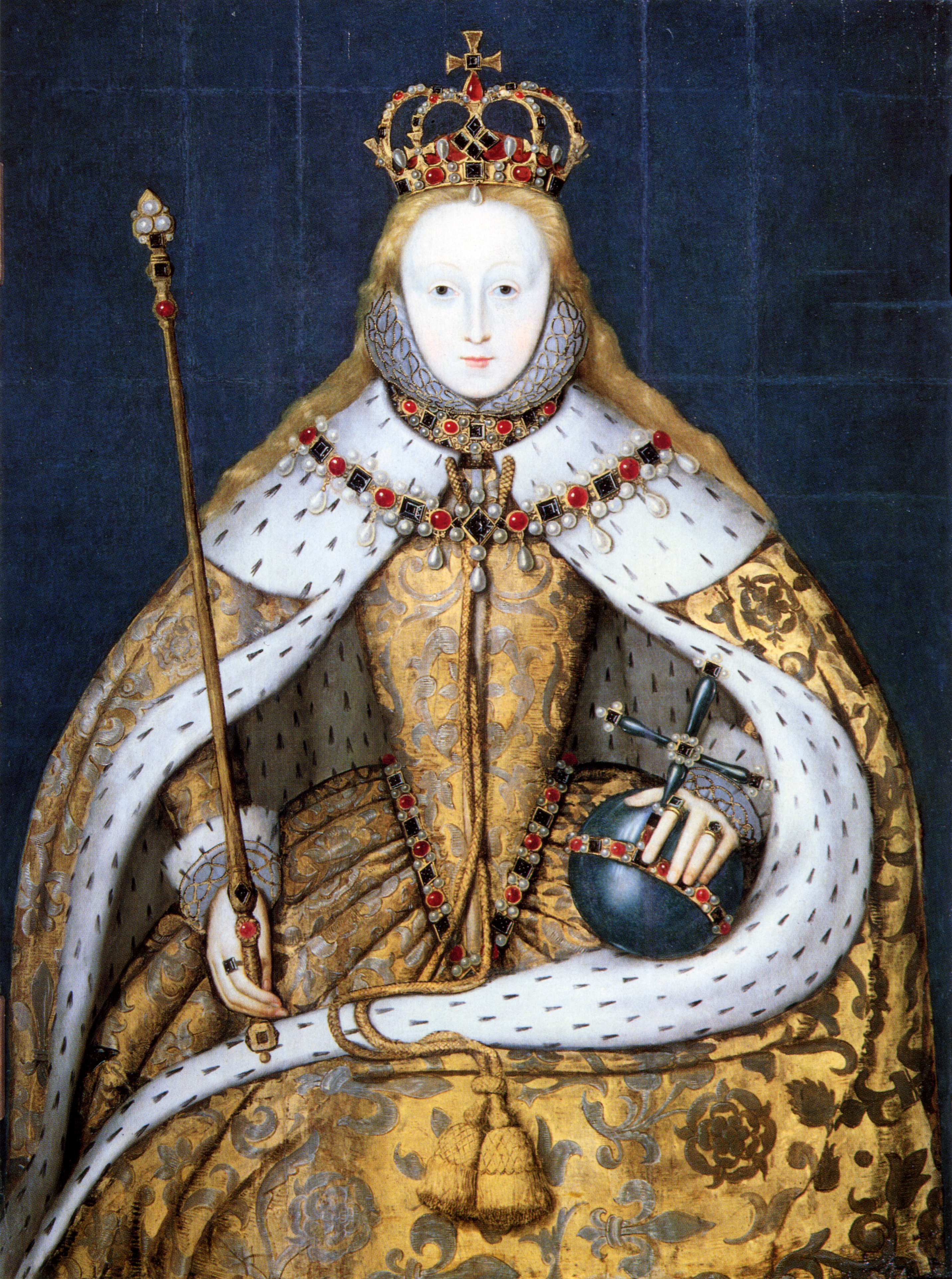
There have been several instances of literary criticism that assert Queen Elizabeth is a symbolized in Spencer’s character of Gloriana in The Faerie Queen. Gloriana is meant to be a representation of Queen Elizabeth and how she was received by the English people. As well as other works of the time period, Spenser’s The Faerie Queen was one of the many works that served as, “timeless reflections of Elizabeth’s perpetuation of ‘her maidenhood in a cult of virginity’ with her virginity seen as a perpetual state (King 32).  One of the most prominent aspects that defined Elizabeth’s role as Queen was her chastity, virginity, and purity. Elizabeth was known as the “Virgin Queen”.

Dominated by a patriarchal society, starting a reign as a female during the Renaissance would not have been an easy task for Elizabeth. However, instead of contending to her gender being a liability in her reign, Elizabeth made it an advantage (King 33). She used her virginity and purity as an advantage in her political career by gaining the admiration and respect of her people. Her image and how she was perceived by the people was everything. She not only maintained an image of virginal purity but also defied the patriarchal traditions of the time. Obviously, it would have been expected for her to marry and bear an heir to the throne. However, Elizabeth chose a rather radical path to remain a virgin and not marry. Modern scholarship has supported that it was entirely Elizabeth’s choice to choose a life of perpetual virginity (33). 

Elizabeth’s idea to defy the gender expectations and social norms for her position somewhat aligned with the changing times of the English Renaissance. New ideas and ways of thinking were being introduced; almost a new way of life. The people were undergoing a dramatic change in lifestyle without even realizing it. In regard to gender roles Rowse asserts that, “There was, too, freedom accorded to women that so much struck outside observers--something like equality” (4). Men and women certainly were not thought to be equal but the ways in which women of higher power were regarded were changing. Elizabeth’s choice of virgingity and to never marry was an indication of this. 

The earliest indication of Queen Elizabeth’s choice to remain pure and never marry was in one her earliest speeches. She describes herself as “already bound unto an Husband, which is the kingdom of England...” indicating that she is already bound in a marriage with her country and her people (King 33). Elizabeth positioned herself as an extremely virtuous woman. It seemed that by making this declaration, she was putting her own personal desires and potential happiness aside for the good of her kingdom. However, there has been speculation that there was more to Elizabeth’s motivations than simply being selflessly dedicated to her people.

Many scholars argue that Elizabeth’s main motivation for her choice of perpetual virginity was to position herself in a way in which she was defying the patriarchal expectations. By declaring she would not marry or bear children, she was defying the very expectations in which she was expected to follow as a woman and as a ruler. King describes Louis Montrose’s argument that by refusing the female expectations of the time, she sought avoidance “to become the medium through which power, authority, and legitimacy are passed through generations of men” (34). Perhaps she wanted control over her reign and did not want to pass off her power to her husband and eventually, her  heir. It is difficult to know if this was actually Elizabeth’s main goal in her choice of virginity, but regardless it defied the norm of a woman her position. 

King also points out that there has been criticism of Elizabeth’s speech that she supposedly never claimed she sought to outset in image upon the beginning of her reign in a view of celibacy but instead just wanted to emphasize her preference for unmarried life (37). Even if the focus of her speech was more focused along the lines of not wanting to focus on marriage, it still defied the expectations of the time period. Everyone knows that marriage and not remaining a virgin go hand in hand. So, by Elizabeth asserting she would like to avoid marriage, she is still saying she will remain a virgin. Even if her emphasis was simply on the act of marriage and not celibacy, she made it clear that she sought to be the head of her own reign and not have a man overshadow her command. 

From this point of view, it could be said that Elizabeth was sort of a feminist of sorts. It is impossible for anyone to ever truly know if Elizabeth’s role as the “virginal queen” was a life decision based on an unwavering devotion to her country, an act of defiance against the patriarchal societal expectations, or a little bit of both. 


 Works Cited

King, John. “Queen Elizabeth I: Representations of the Virgin Queen.” Renaissance Quarterly , Vol. 43, No. 1 (Spring, 1990), pp. 30-74. JSTOR. Web. 6 Oct. 2013.

Rowse, A.L. “The Elizabethan Renaissance: The Life of the Society.” New York: Charles Scribner’s Sons, 1971. Print. 


Wednesday, October 2, 2013

The Dissolution of the Monasteries: What Was the TRUE Purpose?


            In the 1530s, King Henry VIII set forth legal processes to tear down many monasteries throughout England.  Henry ordered the majority of “900 religious houses in England” (Bernard 390) not only to be metaphorically separated in the sense that the communities of people were dissolved but also physically in that the buildings themselves were demolished.  As the head of his own denomination, Anglicanism, Henry not only held political power over his constituents but also self-designated religious authority.  While some historians speculate that the deconstruction of so many of these religious buildings was merely rooted in the maintenance of greed by looting monasteries’ relics rather than caused by ideological dissonance, G. W. Bernard argues that “we should be wary about interpreting the dissolution simply in material terms” (392).  That is, Bernard feels that Henry’s dissolution of these holy buildings had purpose other than that of simply obtaining items of high wealth and monetary value.
            Bernard does concede that Henry’s administration did, of course, take advantage of the materials that they stumbled upon in each monastery, pulling items of importance naturally to increase his own wealth, to assert his monetary dominance over his people.  Because “The revenues of the religious houses… amounted to over £130,000 a year” (Bernard 393), Henry and his cronies saw the opportunity to seize items of worth.  Even some of the less financially valuable parts of monasteries were taken and implemented: “after the dissolution of the monasteries much stonework was torn down and reused in Henry’s works, generally as rubble for foundations, but occasionally for other purposes” (“The King’s Houses – 1485 – 1660” 21).  Still, Bernard states that other purposes were key in Henry’s decision to demolish these buildings, as Henry desired firmly to state his religious presence and “his royal supremacy” (393) and to prove himself the worldly leader of his religion.  Furthermore, Henry not only wished to prove powerful in his religion but also to prove his religion powerful against other ideologies, “rival religious beliefs” (Bernard 393) like the Catholicism of the monasteries.
             The split of Anglicanism from Catholicism was, as many educated people know, Henry’s difficulty to “search for a divorce” (Bernard 395) and his denial from the Catholic Church.  His disagreements in belief, that he as royalty should be allowed divorce, with the Pope caused the “ultimate break with Rome” (Bernard 395), and Henry decided to form his own Christian denomination of the Church of England, inciting the English Reformation.  Bernard argues that Henry’s decision to split after the refusal of his divorce was not necessarily one of political agenda initially but rather that “it was at best embarrassing and at worst threatening to the king” (395).  Once he made the decision to split from the Catholic Church, Henry’s next step was to ensure that his citizens obeyed his orders and fell in line with his commands.
            Worrying that the monasteries, whose roots were Catholic, would stick to their traditional affiliation, “Henry was determined that monasteries should recognize his authority” (Bernard 396).  Henry and his “vicegerent in spirituals” (Bernard 396), Thomas Cromwell, then embarked on trips that were essentially monastery inspections.  Ascertaining wealth of each religious house was, of course, a factor in these treks, but Bernard argues that Henry primarily wanted “to assent royal authority” (396), to guarantee that the monks and friars legitimately considered him to be their leader.  Interestingly, Bernard notes that these inspections revealed much “evidence of sexual misconduct” (397) by several members of the clergy in a range of activity including that with boys and that with nuns, many of whom found themselves pregnant consequently.  As a result of the findings of these inspections, “there were discussions about what should be done to reform the monasteries” (Bernard 399), but these conversations were generally unfruitful.  Alas, the first round of dissolution began.
            The first act that demanded dissolution targeted only the smaller monasteries whose income did not justify their remaining open also because more abuse tended to occur in these smaller buildings.  Henry and Cromwell conveyed that this reformative move was so that “religion is right well kept and observed” (Bernard 399), so finances were not the only factor in their removal.  Ultimately, “Henry VIII was planning to confiscate the treasures of parish churches” (Bernard 400) according to gossip, which initially held no truth.  However, because word of mouth was spreading so fervently, a small rebellion in northern England came to be, forcing Henry to feel as though he had to put his foot down.  As religious and royal leader, Henry demanded the respect and obedience of his citizens, becoming filled with “outright hostility” (Bernard 402).  Bernard notes that ultimately, “At some point in late 1537 Henry and his counsellors [sic]” (404) decided to dissolve monasteries completely, commanding with full force the destruction of buildings and the reaping of worthy artifacts and relics from each one. 
            Bernard finally argues that Henry’s actions were not even completely those of a power struggle or an assertion of dominance, noting that the Church of England was “Catholicism without the pope, without monasteries and without pilgrimages… what he had already rejected was devotion to individual saints” (409), perhaps creating an attempt to be spiritually closer to God.  Regardless of the validity of Bernard’s final hypothesis, he states that wealth and greed were not the primary reasons for the Dissolution of the Monasteries.  Instead, his desire for respect and recognition of his authority in addition to a potentially genuine attempt to reform sexual corruption were the bases of the dissolutions.


Works Cited
Bernard, G. W.  “The Dissolution of the Monasteries.”  History 96.324 (2011): 390-409.  Academic Search Complete.  Web.  2 Oct. 2013.  <http://proxy-s.mercer.edu/login?url=http://search.ebscohost.com/login.aspx?direct=true&db=a9h&AN=65302213&site=eds-live>.
 “The King’s Houses 1485 – 1660.”  The History of the King’s Works.  Ed. Howard Colvin.  Vol. 4.  London: H. M. Stationery Office, 1963.  Print.

Friday, September 27, 2013

There is another Morte Darthur?

Min Hyun Oh
Malory, Morte Darthur: Caxton’s Morte Darthur


            Sir Thomas Malory’s Morte Darthur was written during the late fifteenth century, when the English society was greatly influenced by the War of the Roses and the growth of the bourgeois merchant class (Armstrong 133). After Malory had written this piece of literature, a man named William Caxton found England’s first printing press and began to print and distribute Morte Darthur. Because Morte Darthur was written and distributed in the “intersection of manuscript and print culture,” the text exists in two different forms—the Winchester manuscript and the Caxton edition. The controversy regarding which version the “right” Morte Darthur is has been continuing ever since the Winchester manuscript was found in 1934 (134). There are considerable differences between the two versions, and it is difficult to categorically claim that one is better and truer than the other. In the research article, Armstrong explores Caxton’s Morte Darthur and distinguishes the significant changes that were made to the original manuscript, which in turn reflects the new perception of the reading public during the time period (134).


< Malory's Morte Darthur >


            At the end of the fifteenth century, the late medieval society was reshaping itself in regards to literature. The rise of print production led to a shift in the reading audience: while Malory’s Morte Darthur was targeted for the noble’s enjoyment and enlightenment, Caxton’s version focuses on a wider gamut of reading public that spans from both the nobles and to the bourgeoisie (135). There is also a difference in how Malory and Caxton treat their readership. In Malory’s Morte Darthur, the audience is established based on class, whereas Caxton attempts to construct a comprehensive readership through a new concept of “gender specificity” where he uses gender-focused vocabulary (135). Armstrong claims that among over hundred pieces of Caxton’s prints, Caxton’s edition of Morte Darthur is critical in recognizing the “interrelationship of literacy, gender, and audience” during the late fifteenth century (135). Despite such significance of Caxton’s version, his edition of Malory’s text may not initially seem so different from other works targeted to the male audience; this is because Caxton’s Morte Darthur was written within a literary continuum that is also known as the “Worthies Series” of the 1480s.
            Before going into the idea of the “Worthies Series,” it is important to understand the background of Caxton’s printing culture during the late fifteenth century. As mentioned beforehand, the presence of the printing press gave rise to a transition between manuscript and print cultures. This led Caxton’s printshop to handle several clashing concepts such as: “patronage and entrepreneurship, feudalism and capitalism, and noble and bourgeois” (136). Such balancing of oppositional concepts in Caxton’s prints is noteworthy, for Caxton’s version of Morte Darthur effectively handles the intricate mix of “manuscript, print, gender, class, and consumerism” (136). Consumerism is an interesting aspect in Caxton’s Morte Darthur, for he was able to catch the shift in the readership of the time period. While Malory only targeted the nobility with Morte Darthur, the text attracted the rising merchant class who wished to learn the noble ways (137). Caxton recognized such trend and sought to satisfy the demands for similar books, and thus adroitly satisfied customers from both levels of social classes—forming what Armstrong describes as a “permeable membrane” between the two different groups of readership (137).
            Going back to the concept of the “Worthies Series,” Caxton’s version of Morte Darthur exists between a continuum between two other works in the series—Godefroy de Boloigne and Charles the Great. Caxton intended these three pieces to be read together and tried to amplify the effective deliverance of moral lessons. For example, Armstrong points out that Caxton “admonishes” the reader to receive the lesson from Morte Darthur to “doo after the good and leve the evyl and it shal brynge you to good fame and renomme” (137). This didactic nature builds a clear contrast to Malory’s Morte Darthur, whose intended purpose was to provide “entertainment [and] benefit” to its readers (134). Interestingly, Armstrong highlights how quickly Caxton switches from simple description of the text to instruction of the reader. According to Armstrong, this leads the readers to become “active participant[s] in a drama of good and evil, rather than a passive observer” (140). Another difference between Malory and Caxton can be seen through the Pentecostal Oath in the text. With this oath, Malory idealizes the chivalric values to delineate the early days of King Arthur and to stipulate chivalric values within the law. On the other hand, Caxton mentions the oath on a subtly different note. He codifies the law and improves the gender model established by the Pentecostal Oath. Caxton’s version identifies expectations of knights and lists the masculine virtues, which in turn creates a “corresponding model of feminine virtue” (142). He intentionally deletes all clauses that are offensive to women (ex. the rape clause) and upholds his model of feminine virtue by limitedly mentioning women’s capabilities. According to Armstrong, such revision in Caxton’s Morte Darthur makes the text a literary piece it is truly understood to be. 
            All in all, in spite of the slight differences between the two versions of Morte Darthur, Armstrong suggests the importance of looking at both versions. Malory and Caxton’s editions of Morte Darthur are perceived as a literary conversation where “the voices of script, print, class, gender, and producer-consumer relations intermingle” (145). Even though Armstrong points out the limitation of fully understanding and defining the medieval readership, taking a closer look at Caxton’s Morte Darthur in comparison with that of Malory allows us to see the “cultural continuity” of the fifteenth century (Lawton 246). Not only are we able to observe the shift from manuscript culture to that of print, but also we can observe the deeper intentions of Malory and Caxton—their pursuit of the time without “complicated morality, bold action, and human and divine justice” (Simmons 280). In the large picture, as Armstrong would agree, exploring both editions of the text will become highly conducive to comprehending the developmental period of English literature during the fifteenth century.


                                                                Works Cited

Armstrong, Dorsey. "Gender and the Script/Print Continuum: Caxton's Morte Darthur." Essays in Medieval Studies: Proceedings of the Illinois Medieval Association 21 (2005): 133-150. Web. 23 Sept. 2013. 

Lawton, David. "English Literary Voices, 1350-1500." The Cambridge Companion to Medieval English Culture. Ed. Andrew Galloway. Cambridge: Cambridge University Press, 2011. 237-257. Print. 

Simmons, Clare A. "Re-creating the Middle Ages." The Cambridge Companion to Medieval English Culture. Ed. Andrew Galloway. Cambridge: Cambridge University Press, 2011. 279-298. Print. 


Monday, September 23, 2013

Was there really a historical King Arthur?

This week’s reading, Geoffrey of MonMouth’s Britain is the first narrative account of King Arthur's life. This work, is a collection of imaginative account of British Kings beginning with King Brutus going well into the 7th Century ending with Welsh king Cadwallader. 

The existence of a historical King Arthur has been debated by many historians and scholars alike for centuries. Furthermore, many of these historians and scholars have pointed to evidence (or a lack thereof) to support their claims of whether or not King Arthur (or even existed) ruled in the late 5th and early 6th centuries.  Our textbook suggests that a lack of evidence for King Arthur’s existence has led “Geoffrey of MonMouth’s (the author of The History of the Kings of Britain also known as Historia Regum Britanniae) imagination and status as a historian to become the subject of much debate” (Black et al. 158). For instance, “in 1198 the historian William of Newburgh concluded that the Arthur and Merlin who appear in Geoffrey’s Historia are fictitious characters, not historical ones, and he condemned Geoffrey as the father of lies” (Black et al. 158). While, some historians and scholars have a definitive opinion on the actual existence of King Arthur, some historians and scholars assert that it is probable that King Arthur may have existed even though there is a lack of substantive evidence.  

The Dictionary of the Middle Ages makes reference to several text that give the history of King Arthur’s life and his “supposed” accomplishments and accolades. “the earliest account of Arthur’s supposed flourishing (ca. 490-540) is that of Gildas, whose De excudui et conquest Britanniae was composed in the mid sixth century; it does not mention Arthur. Nearly three centuries passed before the personal exploits, the incredible military victories, and the marks of divine favor associated with Arthur and his noble retainers were celebrated in what case to be an outpouring of writings in many tongues and genres” (Stryaer 564).  Furthermore, this dictionary on the middle ages also questions the validity of several of these texts and proposes that some of these alleged events are unlikely and improbable. However, The Dictionary of the Middle Ages also states that some of the material written on King Arthur could be probable.  According to the section on Arthurian literature in The Dictionary of the Middle Ages
“The first chroniclers’ stark records of these decades came ultimately to be enriched by a far more circumstantial tradition in which the British leader is identified as Arthur and given a more elevated status. No Arthur was known in ancient Celtic lore; but the name was well established in Rome, whence it was transplanted to Britain. For example, Artorius Castor, a distinguished member of the gens Artoria, served as commander of a Roman legion stationed at York In the second century, according to a coffin inscription found in Dalmatia. That the name was adopted by native Britons is readily demonstrated. In particular, Nora Chadwick notes that in Adamnan’s life of St. Columbia, written before 704, a king of Argyll is reported to have a son named Arthur who met death while fighting the Saxons in southeastern Scotland. But evidence that stories about this dimly historical prince ever drifted south to Wales and Cornwall, along with northern British lore about such figures as merlin, is lacking. Nevertheless, that a prototype of some sort existed is probable. Legendary heroes, of course, are commonly folk creations: some local figure too obscure for historical notice is endowed with a brilliant fictional biography, built up largely of old age motifs, such as that of the culture hero who’s parentage is mysterious and whose career ends not in death but with a journey to the otherworld, from which he may be expected to return when needed by his people. (Strayer 564)”

The obvious argument being made here is that while it is probable that a historical King Arthur may have existed in the late 5th to early 6th century, however it is highly unlikely that this is the case. is suggesting that due to an abundance of old age motifs found in the stories of King Arthur’s life then King Arthur may be no more than a common a legendary hero which he states are: of course,  commonly folk creations. However, The Dictionary of the Middle Ages does take into consideration several historical arguments that suggest that King Arthur did exist and rule in the late 5th and early 6th century. For instance, the text mentions the fact that the name Arthur was long established in Rome and transplanted to Britain, and also that there are reports of a king of Argyll had a son named Arthur who died in battle against the Saxons in southeastern Scotland. Nevertheless, The Dictionary of the Middle Ages suggests that there is insufficient evidence to confirm or deny the existence of a Historical King Arthur, therefore the actual existence of a historical King Arthur is unknown.


Works Cited

Black, Joseph, et al. eds. The Broadview Anthology of British Literature: The Medieval Period. Peterborough: Broadview Press, 2009. Print.


Strayer, Joseph R. ed. Dictionary of the Middle Ages. New York: Scribner, c1982-c1989. Print.

Thursday, September 19, 2013

Margery Kempe: Accused of being a what?

Margery Kempe had visions of demons, argued with the Archbishop of York, did a lot of crying, started a brewery, almost got executed for heresy, and talked her husband into a vow of chastity in exchange for dinner dates on Fridays (Broadview 608, 616, 609-610, 609, 618, 613).

As our book introduces her, Margery Kempe lived from around 1373 to 1439 (Broadview 604). To put these dates into perspective, Geoffrey Chaucer lived from 1343 to 1400 (379). Our reading for class, The Book of Margery Kempe, is the earliest surviving autobiography written in English (604). This makes it interesting for what it says about women at the time, as well as the information it gives us about autobiographies and stories from this period. Margery Kempe's story is almost entirely religious. As our textbook says, she "was ... on a self-described quest for sainthood" (604). Our reading follows her from being a proud sinner to her life as a unique kind of Christian.

I had several questions while reading. Why was heresy considered such a serious offense during this time? Why is Kempe on trial for heresy? On page 615 of The Broadview Anthology she is almost imprisoned, accused of being a heretic and a Lollard, and is eventually shackled. For the next few pages she is questioned by the Archbishop. From a surface reading, I did not think she had done anything meriting accusal of heresy, and her actions did not seem to merit the death penalty. I was also confused about what a Lollard was, and it turns out that Lollardy might play a part in why she was accused.

Although many of us know that heresy was a larger offense in medieval England than it is now, it is still worth trying to understand the reason for the magnitude of a heresy charge. A central difference between our society and Medieval England is that we have a legal separation of church and state. They did not: "an accusation of heresy might seem remote and inconsequential; however, in light of the lack of separation between Church and State in medieval England, the charge was life-threatening" (Hall 64). This meant the accused was not only fighting the church, but the state as well.

Lollardy is a slightly different beast. The term "Lollard" was used as a derogatory term for followers of John Wyclif, but its original use was a "name for a religious eccentric or vagabond, usually loosely tied to the church" (Dictionary 7:645). In the looser, original sense, we could say that Kempe was a Lollard, but it remains to be seen whether or not she aligns with Wyclif's beliefs.

John Wyclif held some beliefs that threatened existing religious systems. Wyclif "maintained that secular and ecclesiastical authority depend on grace, and that the clergy, if not in a state of grace, can lawfully (and should) be deprived of their property by the civil power" (Dictionary of the Middle Ages 6:199). Thus, his followers were encouraged to disrupt church structures which were not "in a state of grace". This belief made Lollards dangerous to the established religion. Some Lollards even used Wyclif's charge to purify the church as a license to reclaim corrupt, secular governments: "The doctrine could be interpreted to support insurrection through the dismantling of clerical authority and, by extension, might also apply to those abusing positions of secular power" (Hall 64). Given that the religious and state systems were not entirely separate, a charge of Lollardy was similar--if not identical--to a charge of treason.

Wyclif's teachings included allowing unofficial preachers to speak: "He encouraged his 'poor priests' in their itinerant, unlicensed preaching" (Dictionary 6:199). Kempe does preach in a sense. In the midst of her conflict with the Archbishop, Kempe defends her own teaching and rebuking: "Then the Archbishop said to her, 'You shall swear that you will not teach or scold the people in my diocese.' 'Nay, sir, I will not swear,' she said, 'for I shall speak of God and rebuke those who swear great oaths wherever I go" (Broadview 16). Perhaps here Kempe does resemble a Lollard.

In Literature and Heresy in the Age of Chaucer, Andrew Cole gives a different view on Margery's supposed Lollardy. He puts forth that her ideas are not the reason for her accusal. The accusations against her are based primarily on her external resemblances to Lollards. For example, her frequent bouts of crying and her independent personality align with the stereotypes of a lollard. Lollards were known for loud, emotional outbursts: "And so what they could not achieve by true reason they sought by aggressive bluster, with clamant voice ... and pompous high sounding words" (Henry Knighton, qtd. in Cole 160-161). It is not in her opinions that Kempe appears a Lollard, but in her mannerisms and presentation. Cole writes, "It is 'reason' vs. noise. No wonder, then, that Kempe is often taken to be a 'lollard,' no wonder that her crying is understood by others to be hypocritical, for what often offends is not what she says but how she says it, and how loudly" (161). Given this interpretation, Kempe is not truly a Lollard--even though she may look like one.

In summary, there is not a clear consensus on whether or not Kempe was actually a Lollard. In part, this is because the meaning of the term Lollard was dynamic: it could mean a follower of Wyclif, or simply a religious wanderer. If Cole is correct, it could also mean a religious person who is just loud and emotional. Either way, the charge of Lollardy against Margery Kempe was serious, and she was lucky to avoid penalty.

Works Cited:

Black, Joseph, et al. eds. The Broadview Anthology of British Literature: The Medieval Period. Peterborough: Broadview Press, 2009. Print.

Cole, Andrew. Literature and Heresy in the Age of Chaucer. New York: Cambridge University Press, 1968. Print.

Hall, Kathryn A. "Teaching Margery Kempe in Tandem with the Wife of Bath: 'Wanderynge by The Weye' pairing." South Atlantic Review 72.4 (2013): 59-71. JStor. Web. 17 September 2013.

Strayer, Joseph R. ed. Dictionary of the Middle Ages. New York: Scribner, c1982-c1989. Print.

Sunday, September 15, 2013

Antifeminism in the Wife of Bath

As a character, the Wife of Bath represents a culture confused about the role of women in society. There were many conflicting generalizations being made about women during this time period. Though all assumptions were not deeply embedded in misogyny, they all possessed a deprecating view of women’s sovereignty. Women were seen either “as dangerous temptresses whose company should be shunned by holy men, weak-willed vacillating creatures, easily misled and needing strict supervision for their own good, [or] as delicate merciful peacemakers who needed protection in an evil world” (Jewell 171). Though some women were revered in society, especially those affiliated with the Church, there was still a looming sense of derogation. The idea that women needed to be repressed in some way was widely accepted, especially by the Church. The teachings of the Church “heavily emphasized the submissive role deemed appropriate to women, and their mischievous tendencies if left unchecked (Jewell 171). Despite a woman’s good deeds, intentions, and overall character, she was still just a woman, seen primarily as a relation of Eve, the original sinner. Basically, “it was better to be a secret sinner than a woman” (Minnis 246).
The Wife of Bath
The Wife of Bath focuses most of her prologue defending women’s rights to sexual relationships and condemning Against Jovinian, a popular antifeminist text by St. Jerome. St. Jerome uses scripture to defend his argument that marriage and partaking in sexual relations was an abomination, mainly due to the fact that a woman’s body was considered to stem directly from evil. To St. Jerome, “marriage and whoredom have much in common” (Minnis 254), and it was better to only prostitute yourself to one man (your husband) instead of many men (multiple husbands). In fact, “one of [St. Jerome’s] main motives in writing [his antifeminist text was] the excoriation of women who had behaved rather like the Wife of Bath in rushing from one marriage into another” (Minnis 254). Because it was women’s bodies that were considered evil, by not engaging in sexual activity, women could reach a higher power by being chaste.
The Wife of Bath directly responds to St. Jerome’s argument and uses his same methods to arrive at her conclusions about sex and marriage. Although sex was considered a taboo subject, there was a familiar character troupe in literature during this time which conflicted with the idea that sexual matters shouldn’t be discussed.  “Chaucer’s basic model [for the Wife of Bath] was the literary type of the old woman who teaches the young about love” (Minnis 251). Alastair Minnis, author of Fallible Authors: Chaucer’s Pardoner and Wife of Bath, argues that what the Wife of Bath is advocating for is not all that radical in the context of the old woman character troupe. Although she is arguing for sexual sovereignty for women, the Wife of Bath is really a “tissue of antifeminist discourses relating to sexually aggressive and shrewish women” (Minnis 251). She promotes promiscuity and advocates that women should trick their husbands, things that men would expect women to do.
However, what is important is the way the Wife of Bath is presenting her argument. “The Wife of Bath is engaging not just with male authority but with male methods of argument, the techniques of disputation which were the staple method of intellectual inquiry in medieval schools of higher education, from which women were barred” (Minnis 253). She might not be saying things that are ground-breaking, but using examples from the Bible, however far-fetched they may be, is something innovative. Also, it is not just important that the Wife of Bath is “acting and talking like a man” but that she is “behaving like an educated man…like a preacher, and a real preacher at that, not just a metaphorical one who teaches love-doctrine, as in the Pardoner’s formulation” (Minnis 258). The Wife of Bath uses real passages from the Bible, something most people, even men, did not have access to know. This, according to Minnis, accounts for the Friar’s uncomfortable outburst. By using the Bible to back up her reasoning, the Wife of Bath goes beyond her own stereotype. “There was nothing particularly troubling about an old woman teaching about love and womanly wiles…but the Wife’s Prologue and Tale surmount the confining discourses of that ‘oulde daunce’” (Minnis 259). In that way, the Wife of Bath not only embodies one of the expected stereotypes of womanhood, she uses the discourse of antifeminism to reiterate her point. The Wife of Bath learned the “academic techniques of ‘arguing by authority’” (Minnis 253) from her husband, Jakyn, from being forced to listen to passages from his Book of Wicked Women. Jakyn thought he was teaching her how to be and obedient wife; he actually taught her how to scrutinize textual laws and form her own opinions using those same texts. So, though the Wife of Bath’s character was not actually liberating women through her belief in sexual autonomy, she does represent a woman capable of intellectual discussion, something far more valuable to the construction of rights for women.

Works Cited

Jewell, Helen. Women in Medieval England. New York: Manchester University Press, 1996. Print

Minnis, Alastair. Fallible Authors: Chaucer’s Pardoner and Wife of Bath. Philadelphia: University of Pennsylvania Press, 2008. Print